

Washer Shaking and Vibrating Violently? Here’s Why
Why Is My Washer Shaking So Hard?
A washing machine that rattles, bounces, or shakes across the floor is one of the most common calls we get in Ventura County. It’s startling. It’s loud. And if you ignore it long enough, it can turn into an expensive repair.
The good news? Most of the causes are fixable and some you can handle yourself in minutes. This guide walks you through every reason a washer shakes violently, from the most common to the least obvious, so you know exactly what you’re dealing with.
Is This Actually Dangerous?
Yes, sometimes. A washer shaking hard enough to move across the floor can snap water supply hoses and cause flooding, crack the drum or tub over time, damage internal bearings and the motor, or pull the drain hose loose and flood your laundry room. So this isn’t just annoying – it’s a problem worth fixing before it gets worse.
The Most Common Reason: Unbalanced Load
Before you call anyone, check this first. An unbalanced load is responsible for at least half of all violent shaking complaints.
Here’s what happens: You throw in a heavy item like a comforter, a bath mat, or a pair of jeans, and it clumps to one side of the drum during the spin cycle. The drum is now heavier on one side, so it spins unevenly and that unevenness turns into violent shaking.
What to do: Stop the machine and redistribute the clothes evenly around the drum. Avoid washing just one heavy item alone – pair it with other items to balance the weight. Never overstuff the drum. A drum that’s too full can’t move the clothes around properly. If redistributing the load fixes the problem, you’re done. No repair needed.
Leveling Feet: The Easiest Fix You’ve Never Tried
Your washing machine has four adjustable feet on the bottom. They’re designed to sit flat and level on your floor. If one or more feet are uneven – even by just a fraction of an inch – the machine will rock during the spin cycle.
This is especially common if you recently moved the machine, your laundry room floor is slightly uneven, or the feet have never been adjusted since the machine was installed.
How to fix it: Pull the machine away from the wall. Place a level on top of the machine (a bubble level or your phone’s level app works fine). Turn the front feet clockwise to raise them or counterclockwise to lower them. Most rear feet self-adjust when you tilt the machine back and let it drop – check your owner’s manual. Tighten the lock nuts on each foot once you’ve got the machine level. This takes about 10 minutes and costs nothing. If you’re in Ventura County and don’t want to deal with it yourself, we can level the machine during any service visit.
Anti-Vibration Pads: A Simple Upgrade
If your machine sits on a hard tile or hardwood floor, vibration transfers directly into the floor and amplifies the shaking. Anti-vibration pads are rubber mats you put under each foot. They absorb a lot of the vibration before it hits the floor. You can buy a set for about $15-$25 at any hardware store or online. They work well for machines that shake mildly but aren’t a fix for machines with actual mechanical problems.
Worn Shock Absorbers (Front-Load Washers)
Front-load washers have shock absorbers – usually two or four of them – that cushion the drum during the spin cycle. Over time, these wear out and lose their ability to dampen movement. When that happens, the drum slams against the cabinet with every rotation.
Signs the shock absorbers are bad: The machine shakes violently only during the spin cycle. You can hear a loud banging or thumping sound during spin. The shaking is worse with heavier loads. The machine has been in use for 5+ years.
Replacing shock absorbers requires pulling the machine apart – front panel, drum access, and careful reassembly. This is a job for a technician. On most front-load washers in Ventura County, the parts and labor typically run $130-$220.
Worn Suspension Springs (Top-Load Washers)
Top-load washers use suspension springs to hang the inner tub from the outer cabinet. These springs keep the tub centered during the spin cycle. If one or more springs stretch out or break, the tub hangs unevenly and shakes wildly when it spins.
How to check: Open the lid during the spin cycle. If the inner tub is visibly off-center or swinging side to side, the suspension springs are likely the problem. Replacing suspension springs on a top-loader is moderately involved but usually not expensive. Parts are inexpensive, and the repair typically takes 1-2 hours.
Drum Bearings: When the Shaking Gets Really Bad
The drum in your washer spins on bearings – the same concept as a car wheel bearing. When those bearings wear out, the drum wobbles instead of spinning true. The wobble gets transmitted into violent shaking, especially at high spin speeds.
Warning signs of bad drum bearings: A grinding, rumbling, or roaring sound during the spin cycle. The shaking gets progressively worse over weeks or months. You can grab the drum and feel looseness or play when you rock it side to side. The machine has been used heavily for 7-10+ years.
Drum bearing replacement is one of the more involved repairs. It requires disassembling a large portion of the machine. On some older machines where parts are hard to find, it may not make economic sense to repair. A technician can give you an honest assessment.
Spider Arm Failure (Front-Load Washers)
This one is specific to front-load washers. The spider arm is a metal component shaped like a three-pronged star that connects the drum to the drive shaft. It’s made of aluminum, and over time – especially in areas with hard water – it can corrode and crack. When the spider arm cracks, the drum becomes loose on the shaft. The result is severe wobbling and shaking during the spin cycle, along with loud banging and sometimes scratching sounds.
Ventura County note: Ventura County has moderately hard water. This accelerates the corrosion that breaks down aluminum spider arms. If you have a front-load washer that’s 6+ years old and suddenly starts shaking violently, spider arm failure is a real possibility. This is a significant repair that involves removing the drum completely. Depending on the machine, it may be more cost-effective to replace the appliance.
Motor Coupling Problems (Whirlpool / Maytag Direct Drive)
If you have a Whirlpool or Maytag top-loader with a direct-drive system (most made before 2010), there’s a small plastic motor coupling that connects the motor to the transmission. It’s designed to break before the motor or transmission does – a built-in fail-safe. When the coupling is partially broken, the transmission gets inconsistent power, which can cause the drum to jerk and shake during certain parts of the cycle. Motor couplings are cheap – usually $10-$20 for the part – and the repair is straightforward for a trained technician.
Drive Belt Issues
Belt-driven washers have a rubber belt that connects the motor to the drum pulley. If the belt is worn, stretched, or cracked, it can slip during the spin cycle. A slipping belt creates irregular drum movement and irregular drum movement creates shaking. You may also notice a burning rubber smell during the spin cycle, the drum spinning slower than normal, or squealing sounds during startup. Belt replacement is generally a straightforward repair and one of the less expensive fixes.
Loose Drum Counterweights
Most washers have heavy concrete or plastic counterweights bolted to the outer tub. These weights are there to keep the machine stable during high-speed spin cycles. If the bolts holding a counterweight loosen or break, the counterweight can shift or fall – and the machine will shake hard as a result. This problem usually produces a loud clunking sound in addition to the shaking. If something inside your machine sounds like it’s loose and banging around, a technician should inspect it before you run another cycle.
What to Do Before Calling a Technician
Run through this checklist first. Check the load – is it balanced? Redistribute and try again. Check the floor – is the machine level? Use a level and adjust the feet. Check what’s underneath – hard floors amplify vibration, add anti-vibration pads. Listen carefully – is there grinding, roaring, or banging? Note what you hear so you can describe it. Note when it shakes – only during spin? Only with heavy loads? At all speeds or just high speeds? This information helps a technician diagnose the problem faster and more accurately.
When to Call a Technician
Call a technician if the shaking is happening even with small, balanced loads. If you hear grinding, roaring, or metal-on-metal sounds. If the machine is moving across the floor during the spin cycle. If the shaking has gotten noticeably worse over the past few weeks. Or if you’ve already leveled the machine and balanced the loads and it still shakes badly.
What This Costs to Fix in Ventura County
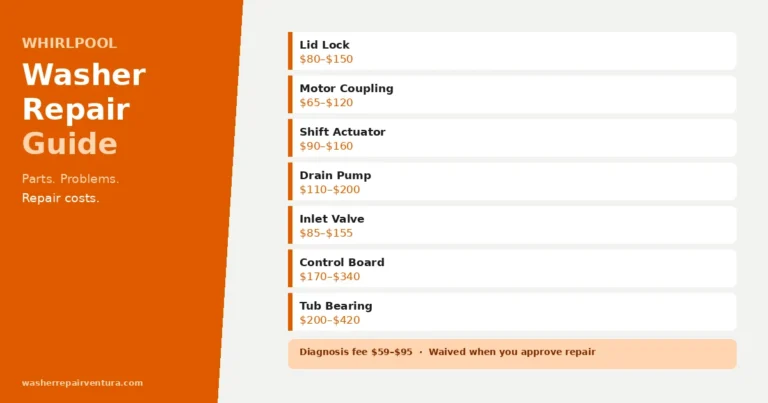
Repair costs vary by the cause. Here’s a general range for Ventura County: Shock absorbers: $130-$220. Suspension springs: $85-$160. Drive belt: $90-$160. Motor coupling: $75-$130. Drum bearings: $180-$320. Spider arm: $200-$380.
We charge a $59-$95 diagnosis fee, which is waived when you approve the repair. We’ll give you an upfront price before any work begins.
Can I Keep Using the Machine Until I Get It Fixed?
Mild shaking that stops when you balance the load: fine to continue using, but get the underlying issue checked. Moderate shaking that doesn’t stop with load adjustment: limit use to small loads and low spin speeds until repaired. Violent shaking that moves the machine or causes banging: stop using it. You risk damaging the water connections, the floor, or the machine itself.
Washer Still Shaking? We Can Help.
If you’re in Ventura County and your washer is shaking harder than it should, give us a call. We service all major brands – Samsung, LG, Whirlpool, Maytag, GE, Kenmore, and more. We can usually get out same day, diagnose the problem, and give you an upfront price before touching anything.
Call us at (805) 912-8855 or book a same-day appointment online.