
Washer Stops Mid-Cycle and Won’t Finish? Here’s Why
Why Does My Washer Stop in the Middle of a Cycle?
You load the washer, press start, and walk away. Twenty minutes later you come back and the clothes are sitting in a tub of soapy water. The machine stopped. It’s not draining, it’s not spinning, it’s just stopped.
This is one of the most frustrating washer problems because it’s not always obvious why it happened. There’s no smoke, no loud noise – the machine just quits. The good news is that there are a limited number of reasons a washer stops mid-cycle, and most of them are fixable.
First: What Does Stopped Mid-Cycle Actually Mean?
Before diving in, it helps to know exactly what stage the machine stopped at. Stopped during the wash (agitation) phase usually means motor or lid/door latch issues. Stopped during the drain phase usually means a drain pump or clog. Stopped during the spin phase often means an unbalanced load, lid switch, or motor overheating. Stopped randomly with no pattern points to the control board, thermal fuse, or an intermittent electrical issue. If you can figure out what stage it stopped at, you’ll narrow the possible causes significantly.
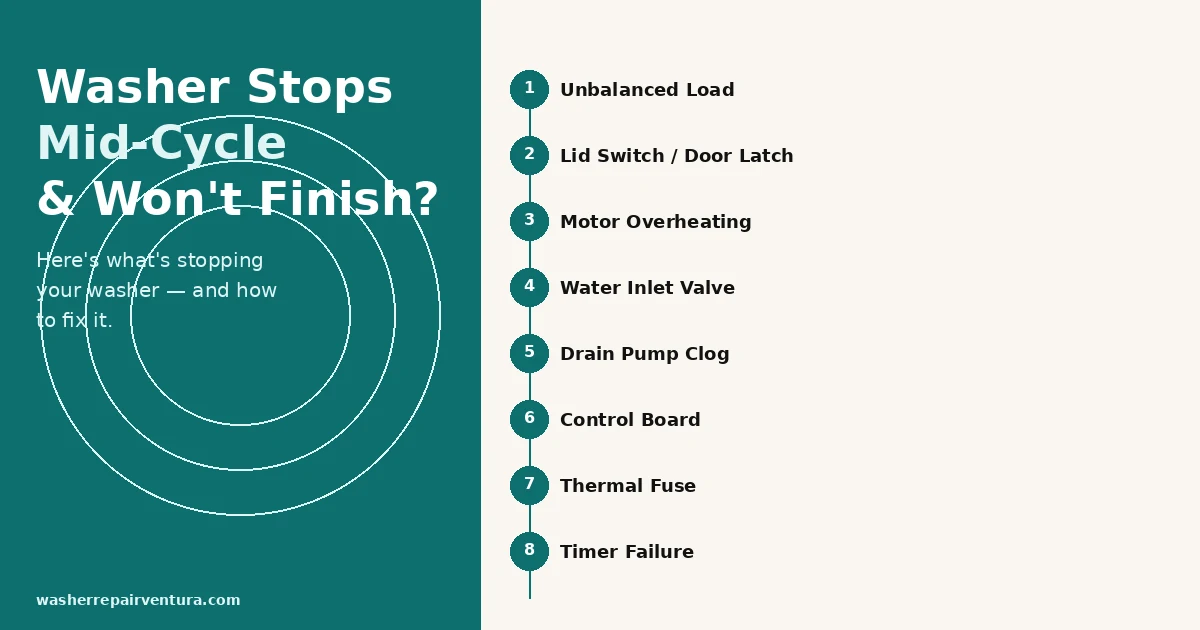
Cause 1: Unbalanced Load Detection
Modern washing machines have sensors that monitor the drum balance during the spin cycle. If the load gets too uneven – too much weight on one side – the machine will stop the spin and try to redistribute by adding water, agitating, and draining again. If it can’t balance the load after a few tries, it stops the cycle entirely and waits for you to intervene.
How to tell if this is the problem: The machine stopped during or just before the spin cycle. The drum still has water in it, or just finished draining. You were washing a heavy, bulky item like a comforter, jeans, or a bath mat. There may be an error code on the display.
Fix: Open the door or lid, redistribute the clothes evenly around the drum, and restart the spin cycle. If the machine lets you restart from spin, you don’t have to redo the whole wash. To prevent this in the future: pair heavy items with lighter ones to balance the load, and don’t overstuff the drum.
Cause 2: Lid Switch or Door Latch Failure
This is one of the most common causes of mid-cycle stops on both top-loaders and front-loaders.
On a top-loading washer, there’s a plastic lid switch that tells the machine whether the lid is open or closed. If that switch fails – even if the lid is completely shut – the machine thinks the lid is open and stops the cycle as a safety measure.
On a front-loading washer, the door latch has a sensor called a door latch interlock. If it stops registering properly, the machine won’t complete the cycle.
Signs of a lid switch or door latch problem: The machine stops mid-cycle but restarts fine after you open and close the lid or door. The machine stops at the same point in the cycle every time. You can hear a clicking sound when you close the lid or door but the machine still stops. On front-loaders: the door feels like it’s latching but the machine won’t proceed.
Lid switches cost around $10-$25 in parts. Door latches are $30-$80. Labor to replace either part is generally straightforward. This is one of the more affordable mid-cycle stop repairs.
Cause 3: Motor Overheating
Washing machine motors have a built-in thermal overload protector. If the motor gets too hot – usually from extended use or a heavy load – this protector trips and shuts the motor down to prevent damage. When the motor cools down, usually 30-60 minutes, it resets itself and the machine will often work again. This is why some people report that their washer fixed itself after sitting for a while.
Signs the motor is overheating: The machine stops mid-cycle, especially during the spin phase. After waiting 30-60 minutes, the machine works again. The problem happens more often with large, heavy loads. The machine has been running for multiple back-to-back cycles.
If this happens occasionally, it may just mean you’re pushing the machine too hard. But if it’s happening regularly with normal loads, the motor may be failing and drawing more current than it should. A failing motor that overheats regularly needs to be evaluated by a technician. Motor replacement is one of the higher-cost repairs, so a tech will assess whether repair or replacement makes more sense given the machine’s age.
Cause 4: Water Inlet Valve Problems
Your washer needs a steady supply of water to complete certain parts of the cycle. If the water inlet valve – which controls the flow of hot and cold water into the machine – is failing, the machine may not get enough water during the wash or rinse phase and stop the cycle.
Signs of a water inlet valve problem: The machine stops during the fill phase at the start of the wash or rinse. The machine takes much longer than usual to fill. You can hear the machine trying to fill but only a trickle of water enters. The machine fills on one temperature setting but not the other.
Before assuming the valve is bad, also check: are the water supply hoses kinked or pinched? Are the shutoff valves behind the machine fully open? Are the inlet screens on the back of the machine clogged with sediment?
Inlet screens are tiny mesh filters where the hoses connect to the back of the machine. They catch sediment from the water supply and can clog over time – especially in areas with hard water like Ventura County. Cleaning them is free and easy: unscrew the hoses, pull out the screens with needle-nose pliers, rinse them under the faucet, and reinstall.
If the screens are clean and the hoses are fine, the valve itself may need replacement. Parts typically cost $30-$80, and replacement takes about an hour.
Cause 5: Drain Pump Clog or Failure
If your machine stops mid-cycle with water still in the drum, the drain pump is worth investigating. The machine is designed to drain before spinning, and if it can’t drain – because the pump is clogged or failing – it stops and waits.
Signs of a drain pump issue: The machine stops during the transition from wash to spin. There’s still water sitting in the drum when the machine stops. You may hear the pump trying to run but nothing drains. There’s a humming sound but no drain action.
The most common cause is a clog in the pump filter or drain hose. Many front-load washers have an access panel at the bottom front of the machine – behind it is a drain filter that collects coins, lint, and small items. This filter needs to be cleaned periodically, every few months. If it’s packed solid, the pump can’t move water through it and the machine stops.
Check the drain hose too – if it’s kinked or the end is pushed too far down into the standpipe, it can create a siphon or restriction that prevents proper draining.
If the pump itself is failing, you’ll need a pump replacement. This typically runs $120-$220 parts and labor.
Cause 6: Control Board Failure
The control board is the brain of your washing machine. It coordinates every part of the cycle – fill, agitate, drain, spin – in the right sequence and for the right amount of time. If the control board develops a fault, it can stop the cycle at any point, seemingly at random.
Signs of a control board problem: The machine stops at a different point in the cycle each time. No obvious mechanical or electrical issue explains the stopping. The machine sometimes works fine, then stops again with no consistent pattern. You see error codes that don’t match any of the mechanical symptoms. Lights on the control panel behave strangely – flickering or unresponsive buttons.
Control board replacement is one of the more expensive repairs – parts alone can be $150-$350 or more, depending on the brand and model. For older machines, it may not be cost-effective. A technician can help you weigh the repair cost against the remaining lifespan of the machine.
Cause 7: Thermal Fuse
Some washers have a thermal fuse – a one-time safety device that blows if the machine gets too hot. Unlike a circuit breaker, a blown thermal fuse doesn’t reset. Once it’s blown, that’s it. The machine won’t run until the fuse is replaced. Thermal fuses are more common on dryers, but some washer models have them. They’re typically inexpensive ($5-$20 for the part) and not hard to replace, but diagnosing a blown thermal fuse requires a multimeter to test continuity.
Cause 8: Timer Problems (Older Machines)
If you have an older top-loader with a mechanical timer knob rather than a digital display, the timer itself can develop faults. The timer controls how long each part of the cycle runs. If a contact inside the timer wears out or burns, the cycle may stop at whatever stage that contact controls. Timer replacement is straightforward on machines where the part is still available.
What to Check Before You Call
Before calling a technician, try these steps. Restart the cycle – sometimes a glitch in the control board clears itself. Try powering the machine off, unplugging it for 2 minutes, then plugging it back in and restarting. Check for error codes – look at the display and write down any codes you see. Check the lid or door – make sure it’s fully latched, try opening and closing it firmly, then restarting. Check the water supply – are both hot and cold valves behind the machine turned on all the way? Check the drain filter if you have a front-loader. Check the drain hose – make sure it’s not kinked and the end isn’t pushed too deep into the standpipe. Note exactly when it stopped – during fill? During agitation? During drain? During spin? This information helps a technician diagnose faster.
When to Call a Technician
Call a professional if the machine stops at the same point in every cycle. If restarting doesn’t help and the machine keeps stopping. If there’s water left in the drum and it won’t drain. If the machine is making unusual sounds before stopping. Or if you’ve already tried the checks above and nothing fixed it.
What It Costs to Fix in Ventura County
Here’s a general range of what you can expect to pay for mid-cycle stop repairs in Ventura County. Lid switch: $75-$130. Door latch: $90-$160. Drain pump: $120-$220. Water inlet valve: $90-$160. Control board: $180-$380. Motor: $180-$320.
We charge a $59-$95 diagnosis fee, waived when you approve the repair. You get an upfront price before we touch anything.
Get Your Washer Finishing Cycles Again
A washer that stops mid-cycle and leaves your clothes sitting in wet, soapy water is a real hassle – especially when you’re trying to get laundry done before work or before the kids need their clothes.
If you’re in Ventura County and need a same-day diagnosis, give us a call at (805) 912-8855 or book online. We service all major brands and can usually get out the same day you call.