
Samsung Washer Repair: Common Problems & Parts That Fail
Samsung Washers: What You Need to Know Before We Dive In
Samsung is one of the most popular washing machine brands in the US. They make well-engineered machines packed with features. But like any appliance, they have specific weak points that tend to show up over time.
If you have a Samsung washer in Ventura County and it’s giving you trouble, this guide covers the most common problems we see, the parts that fail most often, and what you should know before calling for service.
Samsung Washer Model Lines: A Quick Overview
Samsung sells washers across several product lines. Knowing which one you have helps narrow down what might be wrong.
WF front-load series — These are Samsung’s standard front-loaders. Very popular, energy-efficient, but known for a few recurring issues with bearings, door gaskets, and control boards.
WA top-load series — Samsung’s top-loading machines. The WA line includes both agitator models and the high-efficiency impeller models. The impeller models are gentler on clothes but have more electronics to go wrong.
AddWash (WW series) — Front-loaders with a small secondary door on the drum so you can add forgotten items mid-cycle. Solid machines but the secondary door seal is an additional maintenance point.
FlexWash — A two-in-one unit with a front-loader on bottom and a small top-loader on top. Convenient but more complex to repair when something fails.
Most of the problems covered here apply across Samsung’s washer lineup, though some are more specific to front-loaders versus top-loaders.
The Most Common Samsung Washer Problems
1. UE / UB Error Code — Unbalanced Load
The UE or UB code is one of the most frequent Samsung washer complaints. It means the machine detected an unbalanced load and stopped the spin cycle to protect itself.
Samsung’s sensors are quite sensitive — more so than some other brands. This means they catch true imbalance problems well, but they also trip easily on perfectly normal loads that are just slightly uneven.
If you’re getting UE or UB regularly: try smaller loads, avoid washing single heavy items, and make sure the machine is level. If the code appears even with small, balanced loads, the issue may be a failing suspension, worn shock absorbers, or a tub that isn’t sitting centered.
2. 4E / 4C Error Code — Water Supply Problem
The 4E or 4C code means the washer isn’t getting enough water. Before assuming a parts failure, check the basics: are both hot and cold supply valves open all the way? Are the supply hoses kinked? Are the inlet screens (mesh filters where the hoses connect to the back of the machine) clogged?
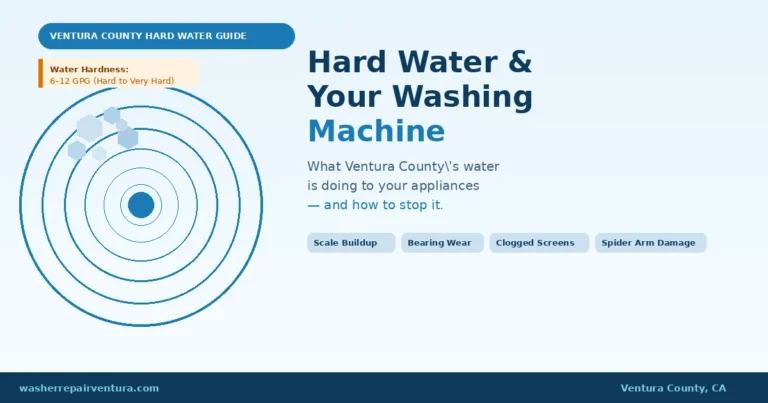
In Ventura County’s moderately hard water, those inlet screens can clog with mineral sediment over time. Clean them every 6-12 months as part of routine maintenance. If the screens are clean and water pressure is fine, the water inlet valve itself may be failing.
3. 5E / 5C Error Code — Drain Problem
This code means the washer can’t drain properly. Start with the drain filter — on Samsung front-loaders, it’s behind the small access panel at the bottom front of the machine. Unscrew the cap, let the water drain into a towel or shallow pan, and pull out the filter. Clean out any lint, coins, or debris and reinstall.
Also check that the drain hose isn’t kinked and that the end of the hose isn’t pushed too far into the wall standpipe (which creates a siphon). If those checks come up clean, the drain pump itself may need to be replaced.
4. Door Latch Failure (Front-Loaders)
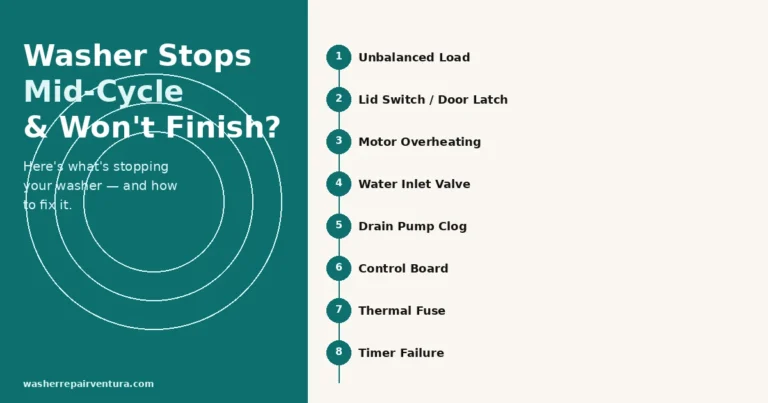
Samsung front-load washers use an electronic door latch that both locks the door physically and sends a signal to the control board confirming the door is secure. When this latch fails — which it does on older Samsung models with some regularity — the machine may refuse to start, stop mid-cycle, or throw a door-related error code (DC, dC, or dE).
You’ll often hear a clicking sound when you close the door, but the machine still won’t proceed. Replacement door latches for Samsung are widely available, and the repair is generally affordable.
5. Drum Bearing Failure
This is one of the more serious and costly Samsung washer repairs. Over time — usually after 6-10 years of regular use — the drum bearings wear out. The first sign is usually a loud rumbling or grinding sound during the spin cycle that gets worse over time.
Samsung front-load drum bearing replacement is a significant job. It requires removing the front panel, the door seal, the drum, and pressing out the old bearing from the outer tub. On some Samsung models the bearing and outer tub are sold as one unit, which significantly increases the parts cost.
If your Samsung front-loader is under 8 years old and otherwise in good shape, a bearing replacement is usually worth doing. If it’s 10+ years old, replacement of the appliance may make more financial sense.
6. Spider Arm / Drum Support Failure (Front-Loaders)
The spider arm is a three-pronged aluminum bracket that connects the drum to the rear bearing shaft. Samsung front-loaders are known to have spider arm failures, particularly on machines that are 6+ years old or used in areas with hard water.
The aluminum corrodes over time, weakens, and eventually cracks — one or more of the three prongs breaks off. When that happens the drum becomes loose and will shake violently, grind, and bang. This repair involves full drum removal and is labor-intensive. Depending on the machine’s age, it may be more practical to replace the appliance.
7. Control Board Issues
Samsung’s control boards are generally reliable but can fail — often due to power surges, water infiltration from a leak, or simple age. Symptoms include the machine stopping randomly, error codes that don’t match any physical symptom, unresponsive buttons, or the machine not powering on at all.
Control board replacement is one of the pricier repairs. A technician can test the board to confirm it’s the actual culprit before ordering parts.
8. Vibration Problems on Samsung Top-Loaders
Some Samsung top-load models (particularly from the 2015-2020 era) developed a reputation for excessive vibration during the spin cycle. Samsung issued a recall and retrofit program for some models in this range. If you have a Samsung top-loader from this period that shakes violently, it’s worth checking whether your model is included in any recall or service bulletin.
Samsung Washer Parts That Fail Most Often
Based on repair history, these are the parts we replace most often on Samsung washers:
Door latch/lock assembly — Fairly common on front-loaders after 3-7 years. Affordable to replace.
Drain pump — Fails from debris clogs or worn impeller motor. Common on both front and top-loaders.
Water inlet valve — Often fails partially (one temperature side fails before the other). Common after 5-8 years.
Drum bearings — Most common on front-loaders after 6-10 years. Significant repair.
Spider arm — Specific to front-loaders, especially in hard water areas. Major repair.
Shock absorbers — Wear out on front-loaders, contributing to vibration and noise.
Door gasket/boot seal — The rubber seal around the front-loader door can develop mold, tears, or small holes over time. Replacement is straightforward.
Control board — Less common but expensive when it does fail.
Samsung Washer Maintenance Tips
A few simple habits will add years to your Samsung washer’s life:
Clean the drain filter every 3 months. This is especially important on front-loaders. A clogged filter strains the drain pump and causes 5E errors.
Clean the door gasket weekly. Wipe down the rubber seal inside and out. Check the fold at the bottom where water and debris collect. Leaving the door open after each wash cycle helps it dry out and prevents mold.
Use HE detergent only. Samsung front-loaders and most top-loaders require HE (high-efficiency) detergent. Regular detergent creates too much foam, leaves residue, and triggers error codes.
Run Self Clean monthly. Samsung’s Self Clean or Eco Drum Clean cycle runs the drum at high heat to remove detergent buildup, mold, and odors. Use it monthly.
Clean the inlet screens twice a year. Especially important in Ventura County where mineral buildup is a factor.
How Long Do Samsung Washers Last?
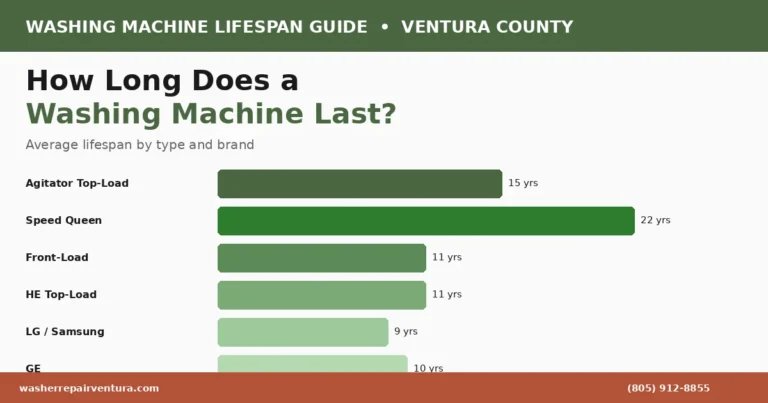
A well-maintained Samsung washer typically lasts 8-12 years. Front-loaders tend to be on the shorter end of that range because of the bearing and spider arm wear that comes with the front-load design. Top-loaders generally have a simpler mechanical design and can push toward the higher end.
If your Samsung is under 8 years old and needs a repair that costs less than $300, it’s almost always worth repairing. If it’s over 10 years old and facing a major repair, get an honest assessment from a technician first.
What Samsung Washer Repairs Cost in Ventura County
Here’s a realistic price range for common Samsung washer repairs in Ventura County:
Door latch replacement: $90-$170
Drain pump replacement: $120-$220
Water inlet valve: $90-$160
Shock absorbers: $130-$220
Door gasket/boot seal: $110-$190
Drum bearings: $200-$380
Spider arm: $220-$400
Control board: $180-$360
Our diagnosis fee is $59-$95, waived when you approve the repair. We give you the price upfront before any work starts.
Samsung Washer Not Working? We Can Help.
We service Samsung washers throughout Ventura County — Ventura, Oxnard, Port Hueneme, Oak View, El Rio, and Saticoy. Same-day service is usually available. Call (805) 912-8855 or book online.