
Hard Water and Your Washing Machine in Ventura County
Does Hard Water Really Affect Your Washing Machine?
Yes, and more than most people realize. Hard water is one of the leading causes of early washing machine wear in Southern California — and Ventura County is no exception.
If you’ve ever noticed a white or gray crust around your faucets, inside your showerhead, or on the inside of your washing machine drum, that’s mineral scale from hard water. It builds up slowly, quietly, and keeps building until it starts causing real problems.
This guide explains what hard water is, what it does to your washer specifically, and what you can do about it right now.
What Makes Water Hard?
Water picks up minerals as it moves through the ground. In Ventura County, the water supply travels through rock and soil that contain calcium and magnesium. By the time that water reaches your home, it carries dissolved minerals with it.
Water hardness is measured in grains per gallon (GPG) or milligrams per liter (mg/L). Here’s a general scale:
Soft water: 0-1 GPG. Slightly hard: 1-3.5 GPG. Moderately hard: 3.5-7 GPG. Hard: 7-10.5 GPG. Very hard: 10.5+ GPG.
Ventura County water typically measures in the moderately hard to hard range — roughly 6-12 GPG depending on the specific water district and time of year. The Calleguas Municipal Water District, which supplies much of Ventura County, has published water quality reports showing hardness levels that qualify as hard to very hard in parts of the county.
That’s high enough to cause noticeable mineral buildup inside appliances over time.
What Hard Water Does to Your Washing Machine
Mineral scale doesn’t show up overnight. It builds slowly, layer by layer, cycle after cycle. But the damage it causes is real and cumulative.
1. Clogs the Inlet Screen Filters
Where the water supply hoses connect to the back of your washing machine, there are small mesh screens called inlet screens. Their job is to filter out debris from the water supply. In hard water areas, mineral deposits build up on these screens and restrict water flow over time.
When the screens get clogged enough, the machine doesn’t fill fast enough and triggers a fill error code (4E on Samsung, IE on LG, F8 E1 on Whirlpool and Maytag). This is one of the most common causes of fill error codes that we diagnose on service calls in Ventura County.
The good news: cleaning the screens is free and takes about 10 minutes. Unscrew the supply hoses from the back of the machine, pull out the screens with needle-nose pliers, rinse them under running water, and reinstall. Do this every 6 months in hard water areas.
2. Builds Up Inside the Drum and Tub
Every load of laundry runs water through your drum. In hard water areas, each cycle deposits a thin layer of mineral scale inside the drum and the outer tub. Over months and years, that scale accumulates into a rough, chalky coating.
This buildup does a few things. It makes the interior surfaces rough, which can snag delicate fabrics. It holds onto soap residue and bacteria, contributing to drum odors. And on front-load washers, buildup in the door gasket folds creates a breeding ground for mold.
Running a monthly cleaning cycle with a descaling cleaner (like Affresh, white vinegar, or a commercial washing machine descaler) helps dissolve this buildup before it gets out of hand.
3. Corrodes and Weakens Drum Bearings
The drum in your washing machine spins on bearings — metal rings that allow smooth, low-friction rotation. In hard water areas, mineral deposits work their way into the bearing area over time, increasing friction and accelerating wear.
This is one reason drum bearing failure is so common in Ventura County. Machines in hard water areas tend to develop bearing wear earlier than the same models in soft water areas. A machine that might last 12 years in a soft water region may see bearing problems at 7-9 years in a hard water area like ours.
4. Degrades the Spider Arm on Front-Loaders
The spider arm is an aluminum bracket that connects the drum to the rear shaft on front-load washers. Aluminum and hard water are a bad combination over time. The mineral content of the water, combined with detergent residue and the heat of wash cycles, causes the aluminum to corrode and weaken.
When the spider arm cracks (one or more of its three prongs breaks), the drum becomes loose and the machine shakes violently, bangs, and grinds. Spider arm failure is a major repair — one that we see more often in hard water service areas than in soft water areas.
5. Reduces Detergent Effectiveness
Hard water minerals react with detergent and reduce its cleaning power. The calcium and magnesium ions bind to the surfactants in detergent before they can do their job on your clothes. The result is that your clothes may not feel as clean, and you may find yourself using more detergent to compensate.
Using more detergent than necessary in a high-efficiency washer creates excess foam and leaves residue buildup in the drum, hoses, and pump. This is a cycle worth breaking: hard water leads to more detergent, more detergent leads to more residue, more residue leads to odors and mechanical problems.
6. Clogs the Drain Pump Filter
Mineral flakes that break off from scale buildup inside the tub can end up in the drain pump filter. A filter that’s partly clogged with mineral debris (mixed in with the usual lint and coins) restricts water flow and makes the drain pump work harder. Over time, a pump that’s fighting a clogged filter will wear out faster than one that drains freely.
Signs Your Washer May Be Suffering from Hard Water Damage
Look for these warning signs:
White or gray scale deposits visible inside the drum or on the door gasket. Your clothes feel stiff or look dull after washing, even with a full detergent dose. A musty or sour smell coming from the drum, even on a clean, empty machine. Fill error codes that appear even though the water pressure and supply valves are fine. Increasing vibration or noise during the spin cycle on a machine that used to run quietly. Detergent and fabric softener dispenser drawers that are caked with white residue.
What You Can Do About Hard Water and Your Washer
Clean the Drum Monthly
This is the single most important thing you can do. Run a hot-water cleaning cycle every month using one of these options:
White vinegar: Add 2 cups of white vinegar directly to the drum (not the dispenser). Run the machine on the longest, hottest cycle available. Vinegar is a mild acid that dissolves mineral scale. It’s inexpensive and effective for routine maintenance.
Citric acid: Mix 2-3 tablespoons of food-grade citric acid with water and add to the drum. Citric acid is a stronger descaler than vinegar and works faster on heavy buildup.
Commercial washer cleaner (Affresh or similar): Drop a tablet in the drum and run the Clean Washer cycle. These products are formulated specifically for washing machine mineral and detergent buildup.
Clean the Inlet Screens Every 6 Months
This takes 10 minutes and can prevent fill errors and inlet valve damage. Unscrew the supply hoses from the back of the machine, remove the screens with needle-nose pliers, rinse them under the faucet, and reinstall. It’s free maintenance that most people never do.
Use a Laundry Booster for Hard Water
Products like Borax or washing soda can be added to your wash to help offset the effects of hard water on detergent performance. They soften the water in the drum, helping your detergent work better and reducing the mineral content that deposits inside the machine.
Use Liquid HE Detergent (Not Powder) in Hard Water
Powder detergent can leave more residue in hard water conditions because it doesn’t dissolve as fully. Liquid HE detergent dissolves completely in the wash water, leaving less residue behind. If you’ve been using powder, switching to liquid is a simple change that can make a real difference in hard water areas.
Consider a Water Softener
If hard water is affecting multiple appliances in your home — your water heater, dishwasher, coffee maker, and washing machine — a whole-house water softener is worth considering. It removes the calcium and magnesium ions before the water enters your home’s pipes, solving the problem at the source.
Water softeners require a salt supply and occasional maintenance, but they significantly extend the lifespan of all your water-using appliances. In a hard water area like Ventura County, the money saved in appliance repairs and replacements often justifies the cost.
Clean the Drain Pump Filter Every 3 Months
On front-load washers, the drain filter is behind the small access panel at the bottom front of the machine. Clean it every 3 months to remove lint, debris, and mineral flakes. On top-load washers, there may not be a user-accessible filter, but the drain hose and pump should be checked if you notice slow draining.
How Often Should You Descale Your Washer in Ventura County?
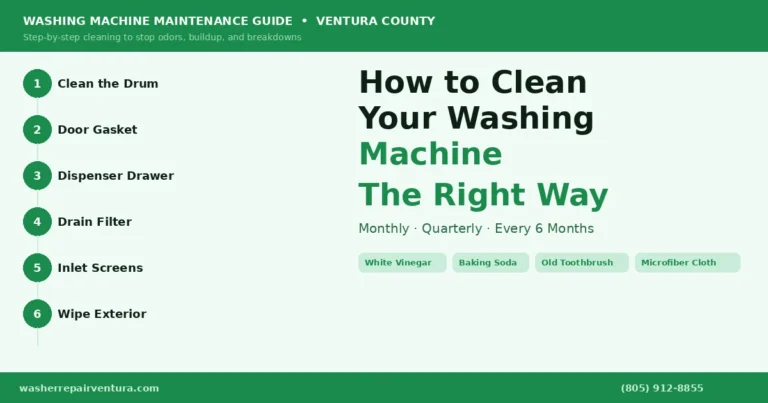
Given Ventura County’s hard water levels, here’s a practical maintenance schedule:
Monthly: Run a drum cleaning cycle with vinegar, citric acid, or a commercial washer cleaner.
Every 3 months: Clean the drain pump filter (front-loaders).
Every 6 months: Clean the water inlet screens. Wipe down the entire drum interior and door gasket with a diluted vinegar solution.
Once a year: Have a technician inspect the drum, bearings, and internal hoses if you haven’t had any maintenance visits recently. Catching mineral buildup or early bearing wear early is much cheaper than repairing it after failure.
Already Have Hard Water Scale Damage? We Can Help.
If your washer is showing signs of hard water damage — fill errors, drain problems, vibration, or unusual noise — we can diagnose and repair it. We service all major brands throughout Ventura County, including Ventura, Oxnard, Port Hueneme, Oak View, El Rio, and Saticoy.