
Washer Repair vs. Replace: How to Decide
Your washer just broke again, and now you’re staring at a repair quote wondering if it’s actually worth it. This is one of the most common calls we get in Ventura County, and the honest answer is: it depends on the age of the machine, the cost of the repair, and how many times you’ve already fixed it. Here’s the decision framework we actually use ourselves when a customer asks us straight up whether to repair or replace.
The 50% Rule
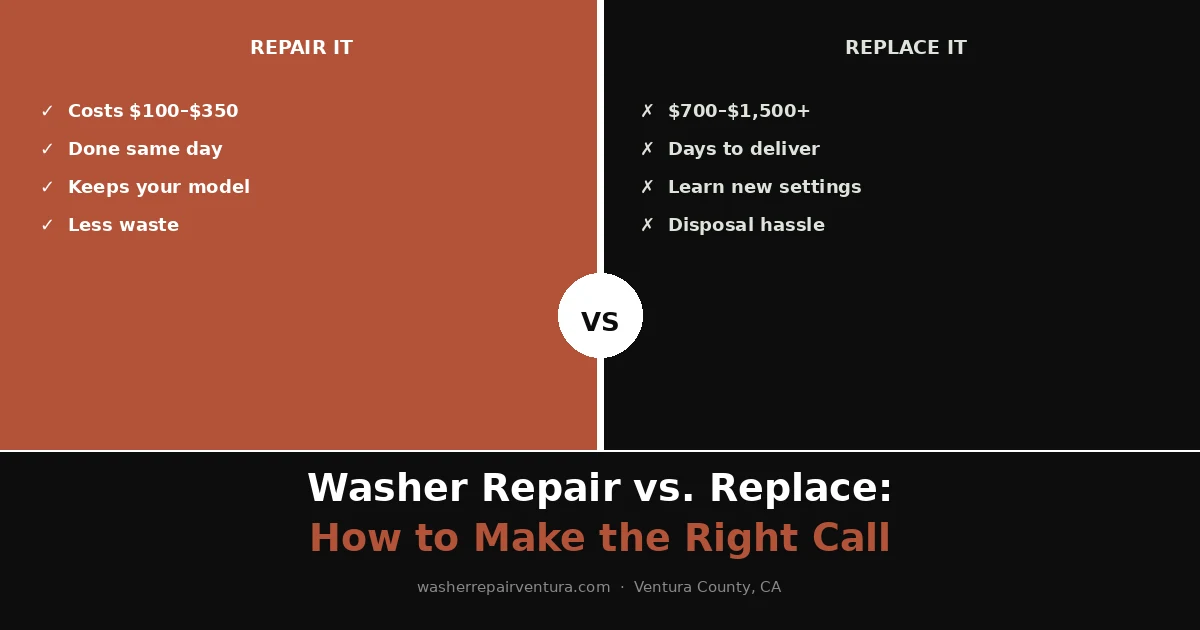
The simplest rule of thumb in the appliance repair industry: if the repair cost is more than 50% of the price of a comparable new washer, replacement usually makes more financial sense. A quote for a $300 repair on a machine that would cost $700 to replace is a reasonable repair. A $450 quote on that same $700 machine starts to tip toward replacement, especially if the machine already has some age on it. This rule isn’t perfect on its own, which is why the next few factors matter just as much.
How Old Is Your Washer?
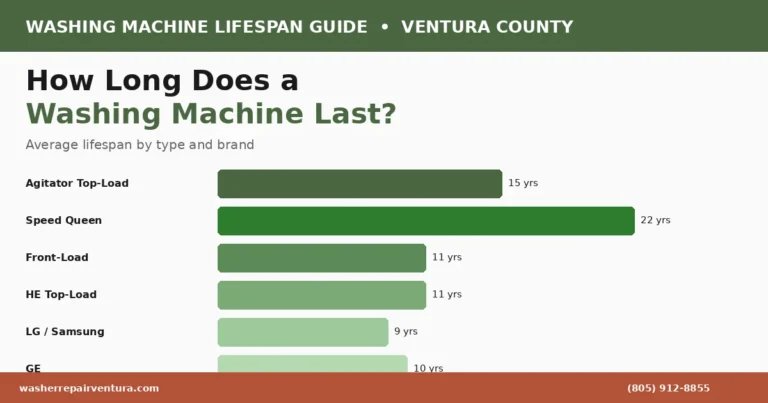
Age changes the math even when the repair itself looks affordable. Most top-load washers last around 10 to 14 years with reasonable care, while front-load and high-efficiency machines typically last 11 to 14 years, though their more complex electronics can start failing a bit earlier in some cases. As a general guide: under 5 years old, repair is almost always the right call, regardless of the fix needed, since the machine has plenty of life left. Between 6 and 9 years, repair is usually still worth it unless the quote is high relative to replacement cost. Past 10 years, weigh the repair cost carefully. Once you’re financing a second or third major repair on a machine that old, replacement often works out cheaper over the next few years.
How Many Times Has It Already Been Repaired?
One repair on an aging machine is normal. Two unrelated repairs within a year or two is a signal the machine is entering a failure cycle where components are wearing out together, not in isolation. If you’re on your second or third service call in 18 months, even if each individual repair seemed reasonable, the pattern itself is worth factoring into the decision. We’ll tell you honestly if we see this pattern on your machine rather than just quoting the next fix.
Repairs That Are Almost Always Worth It
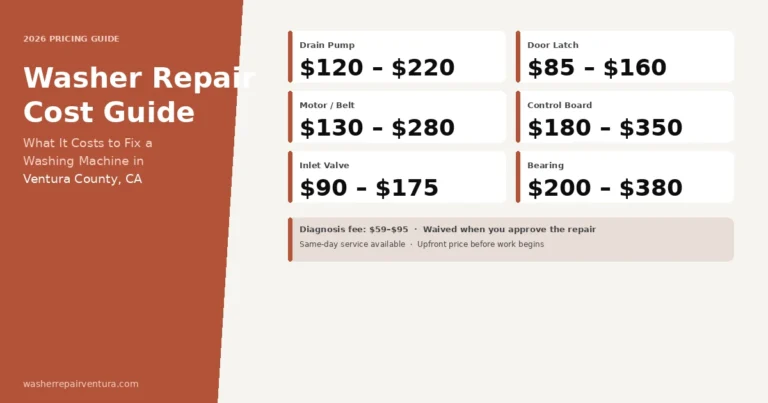
Some failures are inexpensive, quick to fix, and don’t reflect the overall health of the machine. These are usually worth repairing regardless of age, as long as the washer is otherwise running fine: a door lock or latch failure, a clogged drain pump or hose, a water inlet valve issue, or a worn door boot gasket. These parts are relatively inexpensive and don’t indicate the rest of the machine is failing.
Repairs Where Replacement Often Makes More Sense
A few types of failures are worth thinking about harder before repairing, especially on a machine past 8-10 years old: a cracked outer tub (often requires near-full disassembly and a costly part), a failed main bearing on a front-load washer (labor-intensive and sometimes close to the cost of a new machine), a main control board failure on an older or discontinued model (parts can be expensive or hard to source), or a failed motor/transmission assembly on a top-load machine. None of these mean you should automatically replace, but they’re the cases where it’s worth asking us directly whether the repair cost makes sense relative to the machine’s remaining life.
Energy and Water Efficiency
If your washer is more than 10-12 years old, it’s also worth factoring in utility costs. Washers built in the last several years generally use significantly less water and electricity per load than older models, especially older top-load agitator machines. On a marginal repair-or-replace decision, the ongoing savings from a newer, more efficient machine can tip the scale toward replacement even when the repair itself would technically work.
Our Honest Recommendation Policy
We repair washers for a living, but we don’t push a repair when it doesn’t make sense. If we’re out at your home and the numbers point toward replacement being the smarter move, we’ll tell you that directly, including a rough sense of why, before we ask you to spend money on a fix that won’t pay off. If the repair does make sense, we’ll also tell you that, along with our workmanship warranty on the fix. Our full Washer Repair Cost Guide has typical price ranges by problem if you want to see where your specific quote falls.
A Quick Way to Decide
If you want a simple gut-check before calling anyone: is the machine under 8 years old? Repair it. Is the repair quote under half the cost of a similar new washer, and is this the first repair in the last couple of years? Repair it. Is the machine over 10 years old, on its second or third repair, or facing a quote close to half a new machine’s price? That’s when it’s worth seriously comparing the numbers, and we’re happy to walk through that comparison with you on the phone before you commit to anything.
Frequently Asked Questions
Is it ever worth repairing a washer over 15 years old?
Occasionally, if the repair is minor (a simple part, low labor) and the machine has otherwise been reliable. But at that age, we’ll usually walk you through the replacement math too so you can decide with full information.
Do extended warranties change this decision?
Yes — if your washer is still under a manufacturer or extended warranty, repair is almost always the right call regardless of age, since the cost to you may be minimal.
Can you give me a repair-or-replace opinion without charging a full service call?
In many cases we can give you a good general opinion over the phone based on the brand, age, and symptom, though a firm answer usually requires seeing the machine in person.
Are some washer brands more worth repairing than others?
Generally, well-built mid-range machines from brands like Whirlpool, Maytag, Speed Queen, and GE tend to have straightforward, less expensive repairs. Some higher-end front-load machines have pricier electronic parts, which can shift the math sooner.
Warning Signs the Machine Is Nearing the End
Beyond the specific failure you’re calling about, a few signs suggest a washer is generally on its way out rather than dealing with one isolated problem: rust forming around the drum or on the frame (which can eventually lead to leaks that aren’t repairable), a burning smell from the motor area, unusual vibration that’s gotten progressively worse over months even after leveling the machine, and a growing list of small annoyances (a dial that sticks, a lid switch that’s finicky, seals that no longer sit right). None of these alone means the washer is done, but a cluster of them alongside your current repair is a reasonable signal to lean toward replacement.
What to Do While You’re Deciding
If you’re not ready to decide on the spot, it’s fine to ask for time. A few things help in the meantime: get the repair quote in writing so you can compare it against replacement pricing without pressure, ask what the warranty on the repair would cover and for how long, and if the machine is still usable in a limited way (for example, it drains and spins but leaks slightly), ask whether it’s safe to keep using short-term while you shop for a replacement, or whether continuing to run it risks water damage. We’ll always give you a straight answer on that specific point, since a small leak today can become a bigger problem tomorrow if the machine keeps running.
What happens to my old washer if I replace it?
Most appliance retailers offer haul-away when they deliver a new unit. If you’re not replacing through a retailer, local recycling centers and scrap metal yards in Ventura County typically accept old washers, sometimes for a small fee.
Should I repair a washer I’m planning to sell the house with?
If you’re selling soon, a working washer (even an older one) is usually fine to leave as-is if it’s functioning normally. If it’s actively broken, a modest repair is often more cost-effective than replacing it purely for a sale.
Serving Ventura County
Whether you’re in Ventura, Oxnard, Port Hueneme, Oak View, El Rio, or Saticoy, we’re happy to give you a straight answer over the phone before you spend a dime.