
How Long Does a Washing Machine Last?
How Long Should a Washing Machine Last?
Most washing machines are built to last about 10 to 13 years. That’s the number you’ll find in most appliance guides, and it’s a reasonable average for a machine that gets used a few times a week in a typical household.
But that number isn’t fixed. Some machines die at 7 years. Others keep running at 15 or even 20. The difference usually comes down to how the machine was used, how well it was maintained, and a bit of luck with the specific model. This guide covers how long different types and brands of washers tend to last, what shortens their life, what extends it, and how to know when it’s time to let go.
Average Lifespan by Washer Type
The type of washer you have makes a meaningful difference in expected lifespan.
Top-Load Washers with Agitator
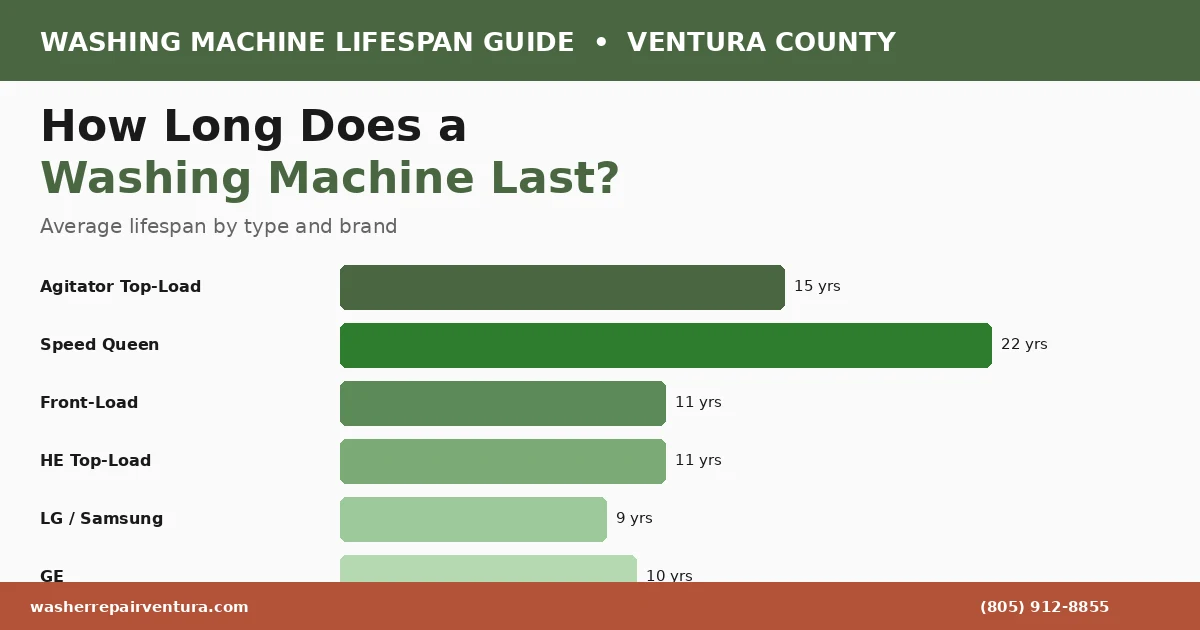
These are the traditional washers with the tall center post in the middle of the drum. They’re the simplest design mechanically, which means fewer parts that can fail. Average lifespan: 12-15 years. Agitator top-loaders are generally the most durable washer type. They use proven technology that hasn’t changed much in decades, parts are widely available and inexpensive, and repairs tend to be straightforward. If you have one of these in good working condition, it’s worth repairing most problems rather than replacing.
Top-Load Washers without Agitator (High-Efficiency)
High-efficiency top-loaders don’t have the center post. They use a low-profile wash plate at the bottom of the drum and use less water. They’re gentler on clothes and more energy-efficient, but the electronics and sensors add more complexity. Average lifespan: 10-12 years.
Front-Load Washers
Front-loaders are the most energy-efficient and gentlest on clothes, but they’re also the most mechanically complex. They have more components – door seals, bearings, shock absorbers, spider arms – that can wear out. They also require more careful maintenance to avoid mold and odor issues. Average lifespan: 10-13 years. Front-loaders can last longer than average if they’re maintained well. They can also fail earlier if they’re neglected.
Average Lifespan by Brand
Brand matters, but maybe not as much as you’d think. The same brand can produce excellent machines and mediocre ones depending on the model and year.
Whirlpool and Maytag
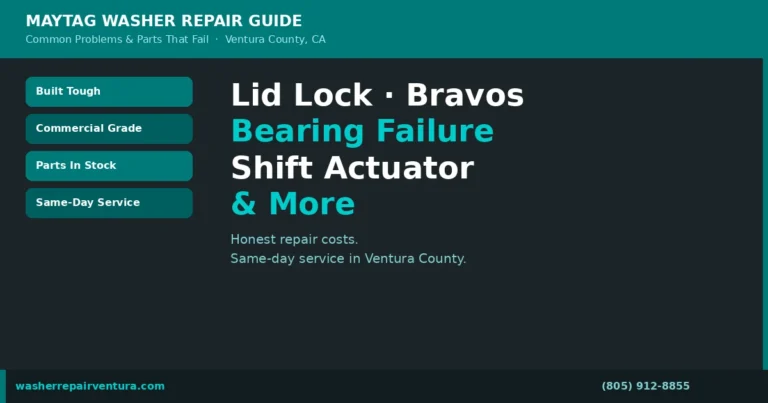
These two brands share engineering (both owned by Whirlpool Corporation). They’re known for reliability and longevity. Parts are widely available across the US, and repairs are generally affordable. Traditional Whirlpool and Maytag top-loaders regularly hit 12-15 years with reasonable use.
Speed Queen
Speed Queen builds some of the most durable residential washers available. Their commercial-grade machines are designed for laundromats where machines run 10-15 cycles per day. For home use, Speed Queen washers frequently last 20-25 years. The trade-off is price – they cost significantly more upfront.
LG and Samsung
LG and Samsung produce feature-rich washers with excellent energy efficiency. They tend to perform well in the first 7-10 years. Beyond that, some models develop issues with bearings, control boards, and drum components. Parts availability can be a factor for older models – sometimes parts for a 10-year-old Samsung or LG are hard to find or expensive.
GE
GE (now owned by Haier) makes solid, reliable machines. They tend to land in the middle of the pack for longevity – generally 10-12 years for most models. Parts availability is good.
Kenmore
Kenmore is a brand sold through Sears whose machines were manufactured by Whirlpool, LG, and other companies depending on the model number. Longevity varies significantly. Many Kenmore machines that were Whirlpool-built have excellent durability.
What Shortens a Washer’s Life
Several habits and conditions will shorten a washing machine’s lifespan well below average.
Overloading
This is the single biggest factor in premature washer failure. Stuffing too much into the drum puts enormous stress on the motor, the bearings, the suspension, and the drive system. A machine that’s regularly overloaded will develop bearing wear, suspension problems, and motor fatigue years before it should. A good rule: the drum should be no more than three-quarters full. Clothes should be able to move around freely.
Using Too Much Detergent
More soap does not mean cleaner clothes. Excess detergent leaves residue inside the drum, tub, and hoses. Over time that residue builds up, promotes mold growth, and can clog components. High-efficiency washers are especially sensitive – they use very little water, so excess soap creates thick foam that the machine can’t rinse out. Use only HE detergent in HE machines, and use less than you think you need.
Hard Water
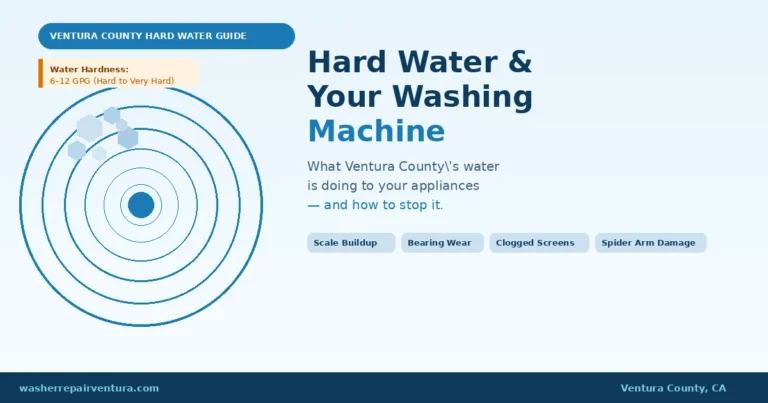
Ventura County has moderately hard water. Hard water contains dissolved minerals – primarily calcium and magnesium – that leave deposits inside your machine over time. These deposits build up inside the drum, the inlet valve screens, the hoses, and on the drum bearings, accelerating their wear. Running a monthly cleaning cycle with a washing machine cleaner or white vinegar helps slow this buildup. A water softener is a longer-term solution if hard water is a persistent problem in your home.
Skipping Maintenance
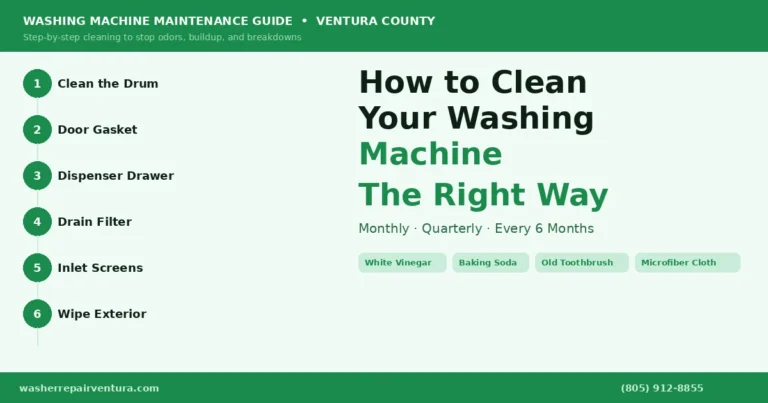
Washing machines need occasional maintenance. Door gaskets on front-loaders need to be wiped down regularly to prevent mold. The drain filter needs to be cleaned every few months. The drum interior should be cleaned periodically to remove detergent residue and mineral buildup. Machines that never get any maintenance tend to develop problems earlier than those that get basic upkeep.
Washing Items That Shouldn’t Go in the Machine
Large rugs, heavily soiled work clothes with sand or gravel, items with metal hardware – these can all damage the drum, the drain pump, and other components. Coins left in pockets are a surprisingly common cause of drain pump failure.
Ignoring Early Warning Signs
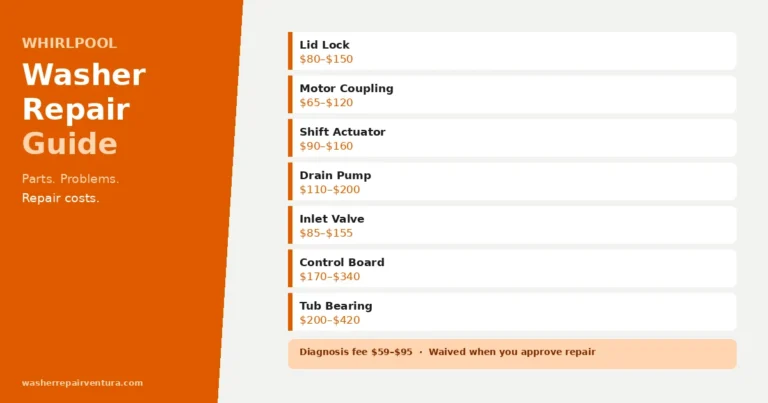
A machine that’s making a new noise, leaking a small amount, or vibrating a little more than usual is telling you something. Small problems in washing machines tend to get worse if ignored. What starts as a $90 belt replacement can become a $320 bearing replacement if you keep running the machine in a degraded state.
What Extends a Washer’s Life
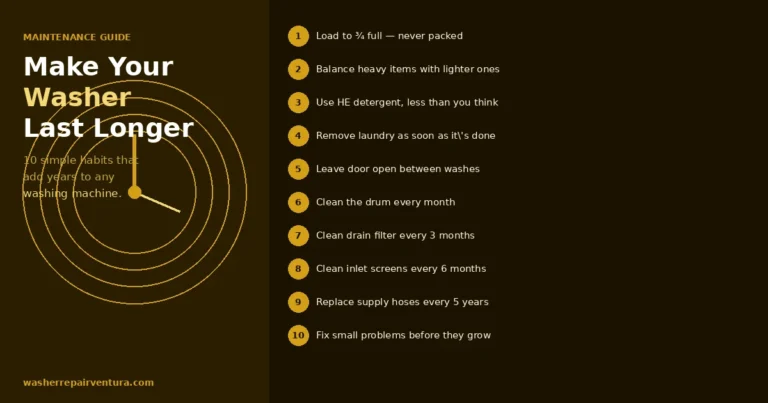
The habits that extend a washer’s life are mostly simple and cost nothing. Load correctly – fill to three-quarters full, no more. Pair heavy items with lighter ones to balance the load. Use the right detergent and the right amount – HE detergent for HE machines, and less than the cap suggests. Leave the door open after washing on front-loaders – this lets the drum and door gasket dry out between cycles, preventing mold growth. Clean the door gasket monthly – wipe it down with a damp cloth and check for debris in the folds. Clean the drum every 1-3 months – run a cleaning cycle with a washer cleaner tablet, white vinegar, or baking soda. Clean the drain filter every 3 months on front-loaders. Check the hoses annually – look for cracks, bulges, or signs of wear. Rubber hoses should be replaced every 5 years. Don’t sit on the machine or pile heavy items on top. Repair small problems promptly – a $100 repair today is better than a $350 repair in six months.
Is Your Washer Worth Repairing?
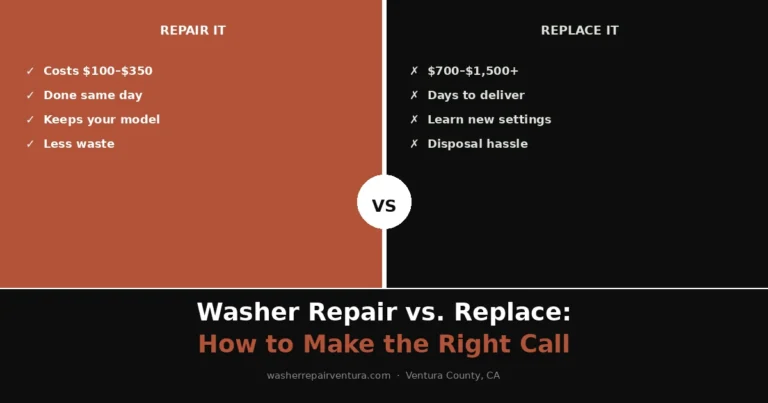
A common rule in the appliance repair industry is the 50% rule: if the repair costs more than 50% of the cost of a new comparable machine, replacement is often the smarter financial move. But that’s just a guideline, not a law. Here are the factors to weigh.
Age of the machine
A machine that’s 4 years old and needs a $200 repair is almost always worth repairing – it has 6-9 years of useful life left. A machine that’s 11 years old and needs a $200 repair is a closer call – it may have only 1-3 years left, and more repairs may follow.
What’s failing
Some repairs signal a machine in overall decline. Drum bearing failure on a 10-year-old front-loader, for example, often means the drum has worn unevenly throughout and other failures are likely to follow. Other repairs – a broken lid switch, a worn belt – are isolated failures that don’t indicate broader decline.
Cost of replacement
A basic reliable new washer costs $600-$900 in 2026. A mid-range model is $900-$1,300. Repairs that cost $200-$350 are often worth doing on a machine that still has usable life, compared to paying $600-$900 for a new one plus the time and hassle of delivery and installation.
Energy efficiency
Newer machines are significantly more water and energy-efficient than machines made 10-15 years ago. In California where water rates are high, the monthly savings on your utility bills from a new machine might offset some of the purchase cost.
Signs Your Washer Is Near End of Life
These signs suggest a machine is approaching the end of its useful lifespan rather than just needing a single repair. Multiple components have failed in the past 1-2 years. The machine is 11+ years old and needs a major repair like bearings, motor, or control board. Parts are no longer available for your specific model. The drum is cracked, warped, or badly corroded inside. The technician advises against repair given the machine’s overall condition. The repair estimate exceeds 50-60% of a new machine’s cost.
How to Get the Most Life Out of Your Current Machine
If your machine is running well and you want to keep it that way: set a monthly reminder to run a cleaning cycle. Set a quarterly reminder to clean the drain filter on front-loaders. Set an annual reminder to inspect the water supply hoses. And don’t ignore noises, leaks, or performance changes – get them checked early.
Washer Questions? We’re Here in Ventura County.
If your washer is acting up, making a new noise, or you just want a professional opinion on whether it’s worth repairing, give us a call. We service all major brands throughout Ventura County – including Ventura, Oxnard, Port Hueneme, Oak View, El Rio, and Saticoy.
We’ll give you an honest assessment and an upfront price before any work begins. Call (805) 912-8855 or book online.